 GoLocomotive
Warranty claims
Each warranty claim on the right cover, with its contract
A leak on a motorhome still covered: the claim starts from the work order, on the cover that holds that day, with its contract. The app chases it while the issuer is silent, keeps the removed part, and records the answer line by line.
What the module does
A claim, its covers and its parts in one place, from the work in the workshop to the settlement.
Each good’s covers
Maker, extension, the dealer’s own warranty, insurance: each with its issuer, its dates, its mileage cap and its contract.
The right cover, and why
The claim rests on the cover that holds on the day of the failure and at that day’s mileage; the app says why it is the one, and offers the one that comes first.
Nothing leaves without its contract
A claim is not sent without lines, an issuer, a cover and its contract, and goes to its cover’s issuer, never another.
Chased while nobody answers
The answer due date, the late badge, then a reminder to the person who follows the claim every three days.
Granted line by line
A full or partial grant line by line, a refusal with its reason, the settlement with the credit note’s reference; a settled claim never changes.
The parts kept
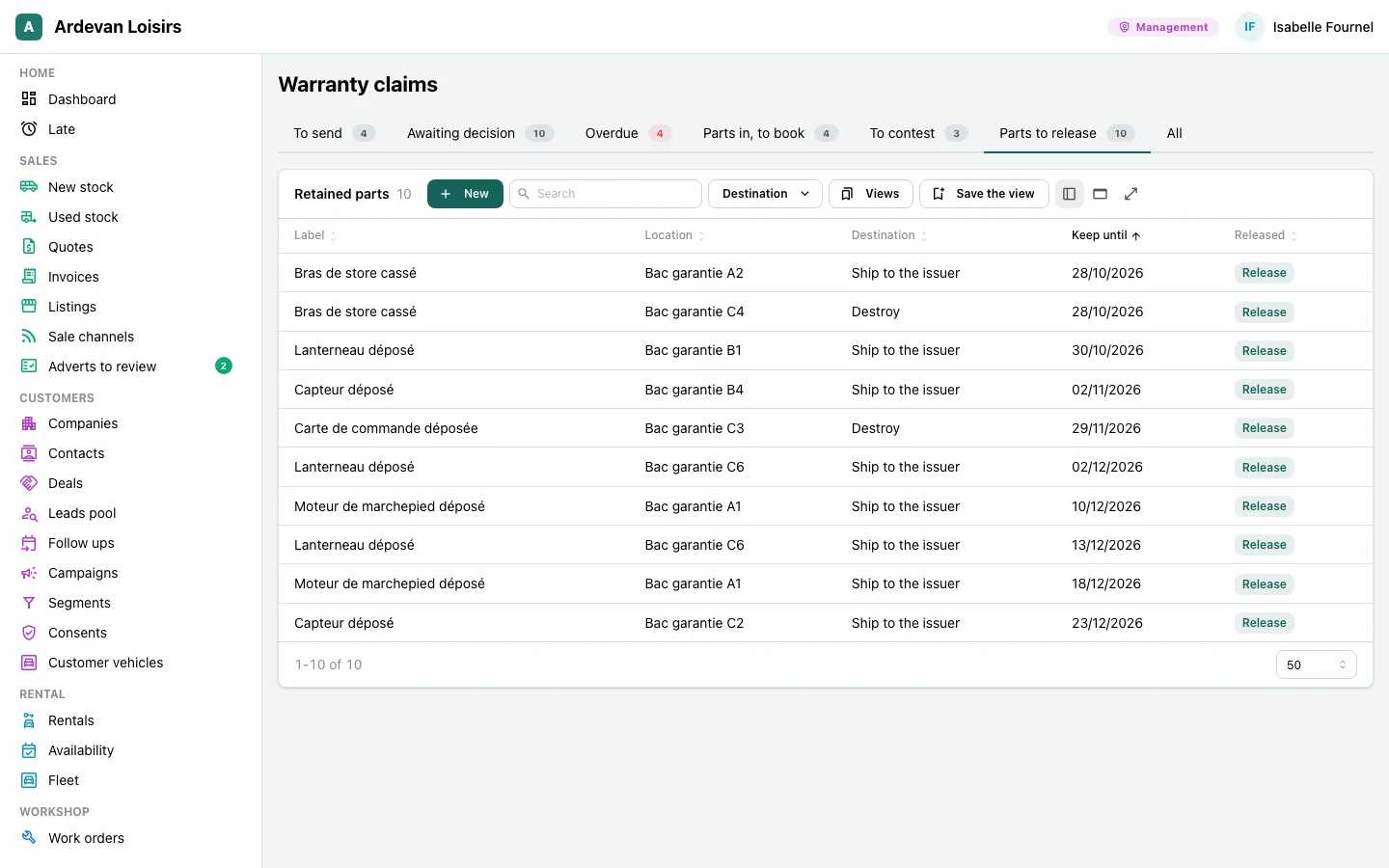
The removed part kept until its day; a part to destroy stays while its claim is open.
Not there yet
- Mailing the claim to the issuer with its lines as a document: today it goes through the issuer’s portal or by phone.
- The issuer’s reference read from its answer mail.
- A reminder to the staff when a cover ends.
Screen by screen
The screens come from the example app of a leisure vehicle dealer, on made up data. In your app, they carry your words, your goods and your issuers.
After sales, warranty desk
Prepare the claim, on the right cover
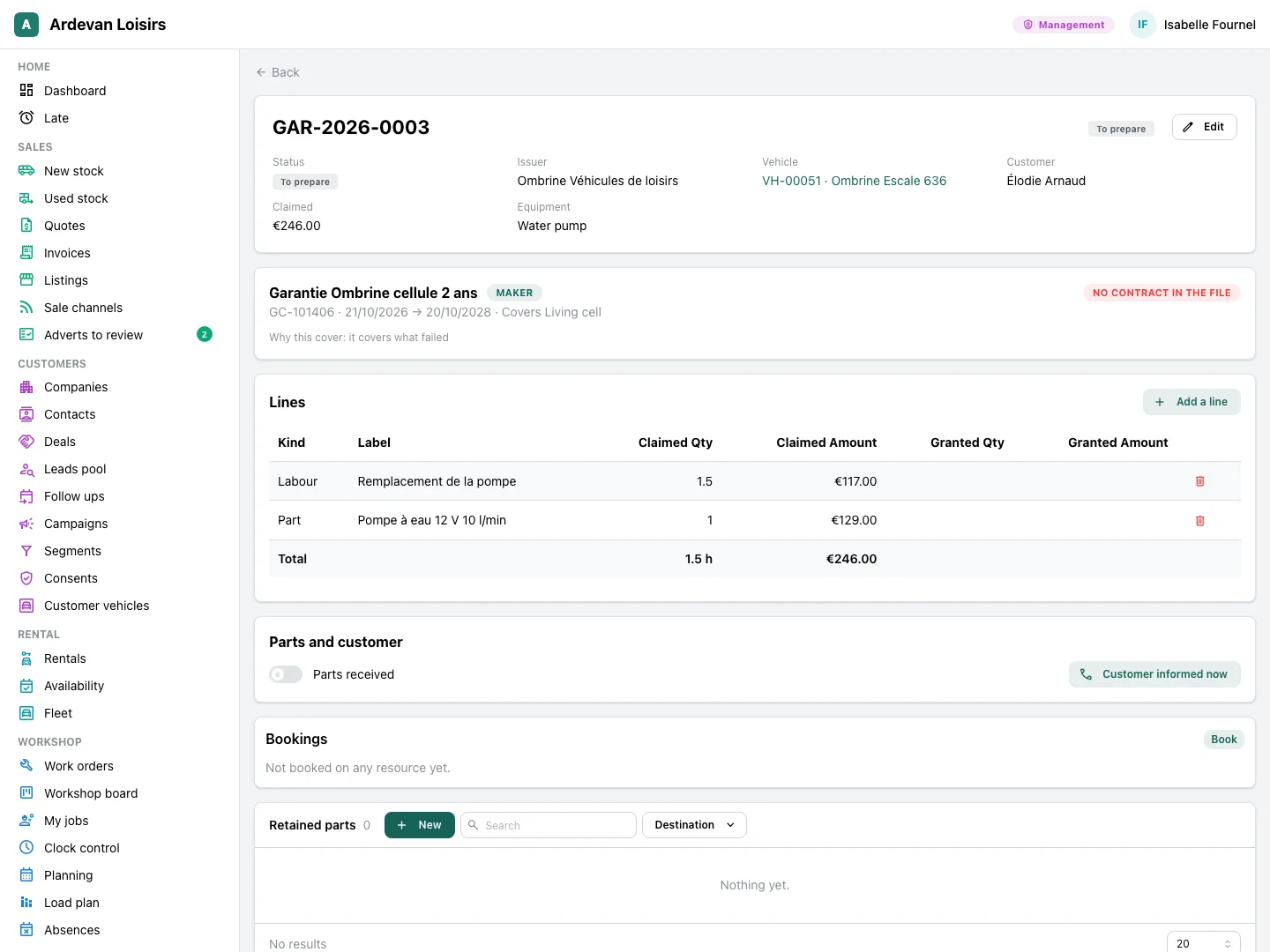
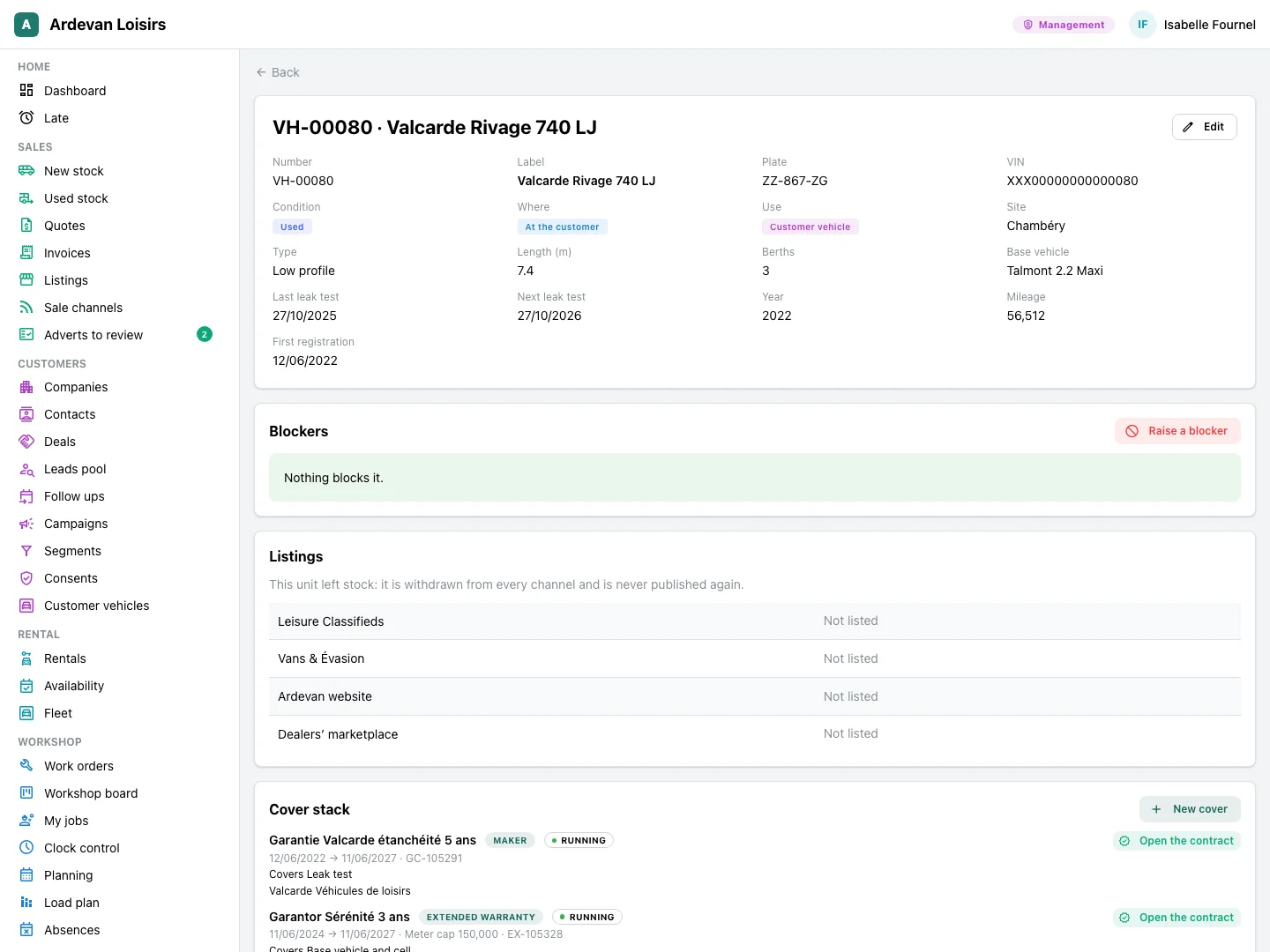
The app offers the cover that holds on the day of the failure, takes the job’s lines, and keeps each cover’s contract in the vehicle’s file: a claim without it does not leave.
- The claim is declared in one click from the work order: the running covers, the right one first with its reason.
- The labour, parts and sublet lines taken from the job, with their hours and amounts.
- On the vehicle’s page, all its covers, running or ended, each with its contract to open.
- When the work order is billed, its warranty lines go to the claim, never to the customer.
Warranty desk
Send, then follow the answer
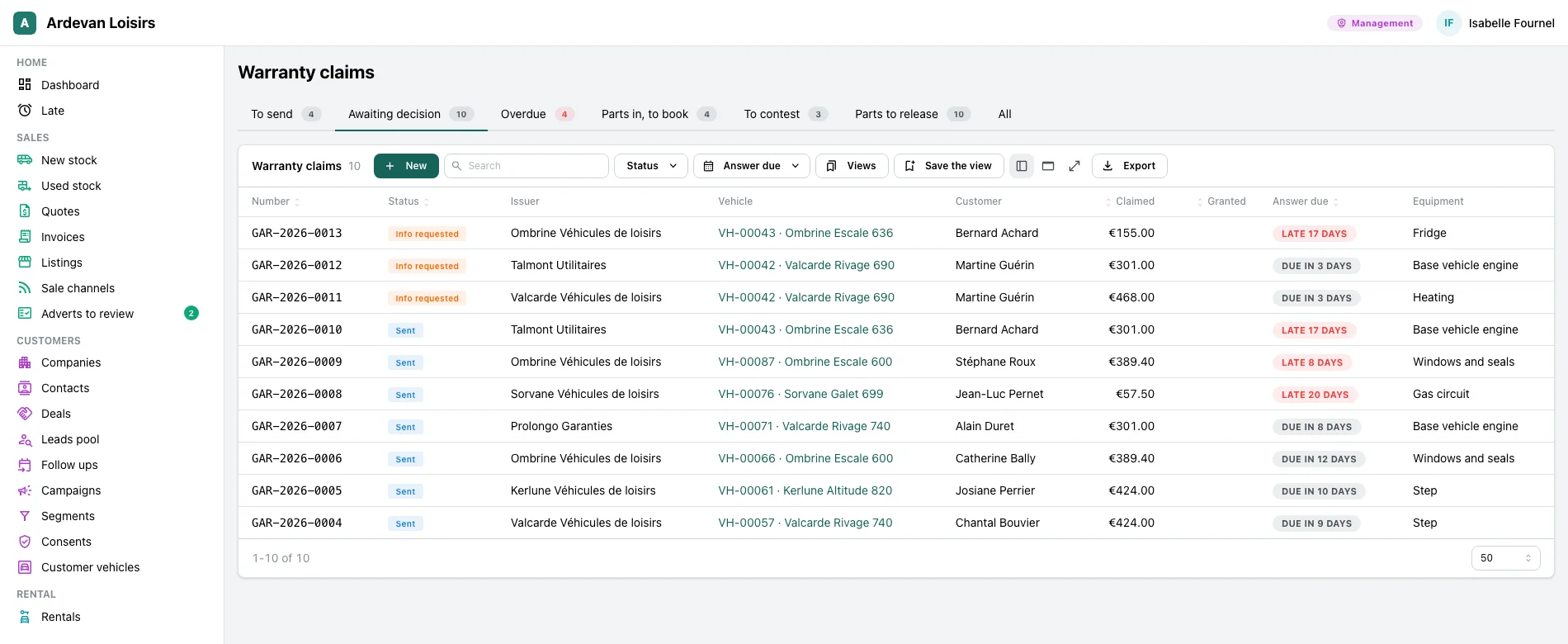
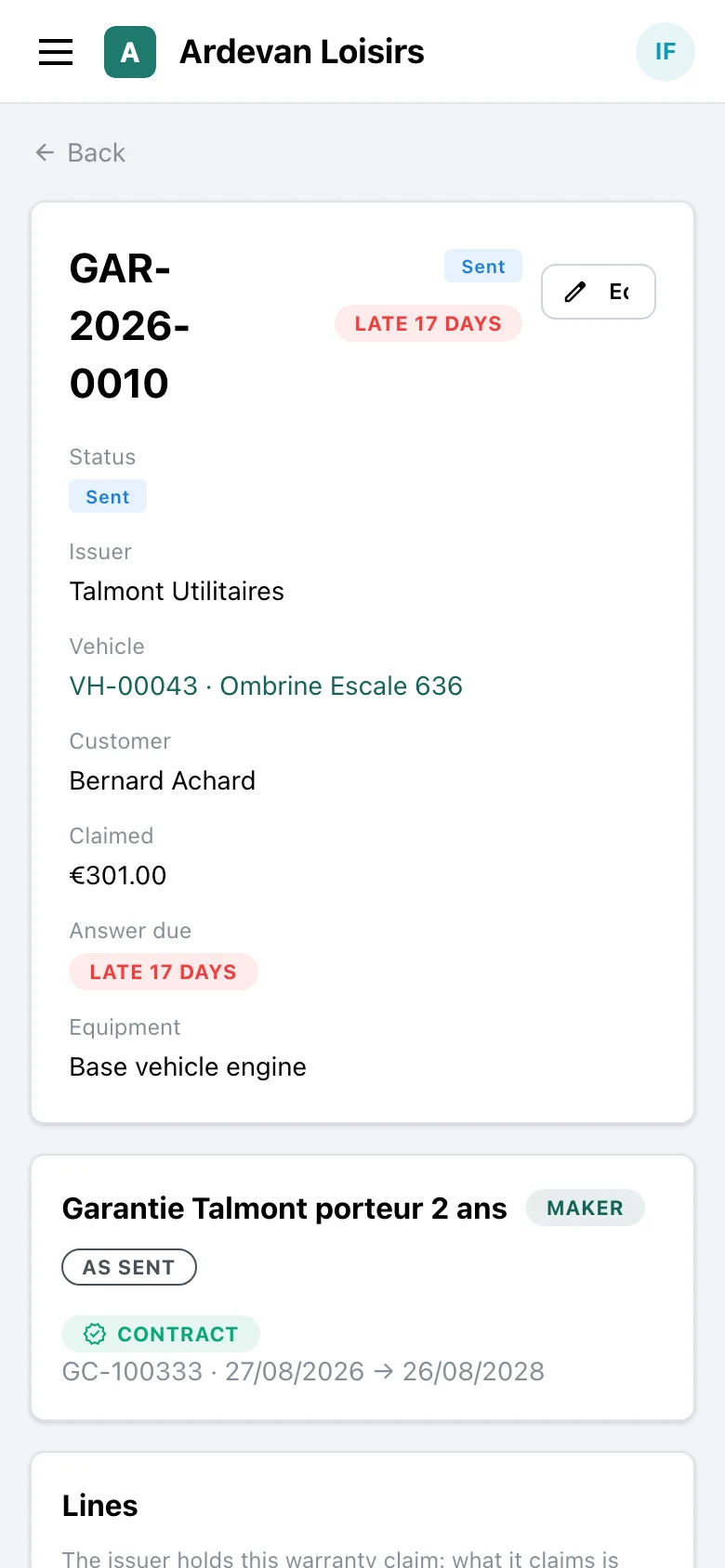
A claim sent waits fifteen days for its answer. Past that, it turns late and the app chases, with no spreadsheet to colour by hand.
- Sending asks for the channel and the issuer’s reference, and keeps the cover as it was sent.
- The answer due on each claim, late in red, in how many days otherwise.
- A request for information from the issuer, then the claim sent again with the answer.
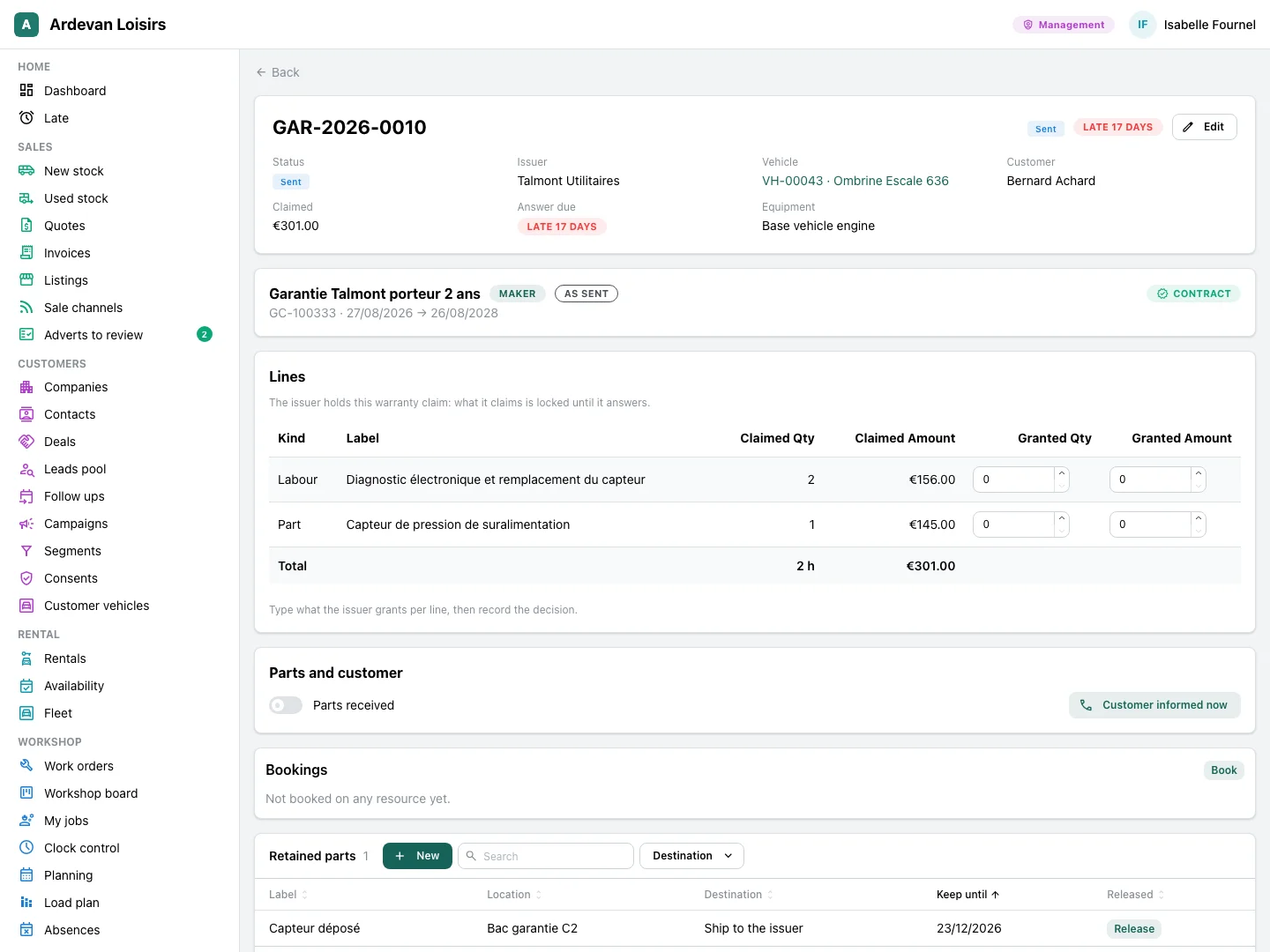
- What the issuer holds no longer moves: the lines claimed are fixed until it answers.
Warranty desk, management
The grant, the settlement, the acceptance rate
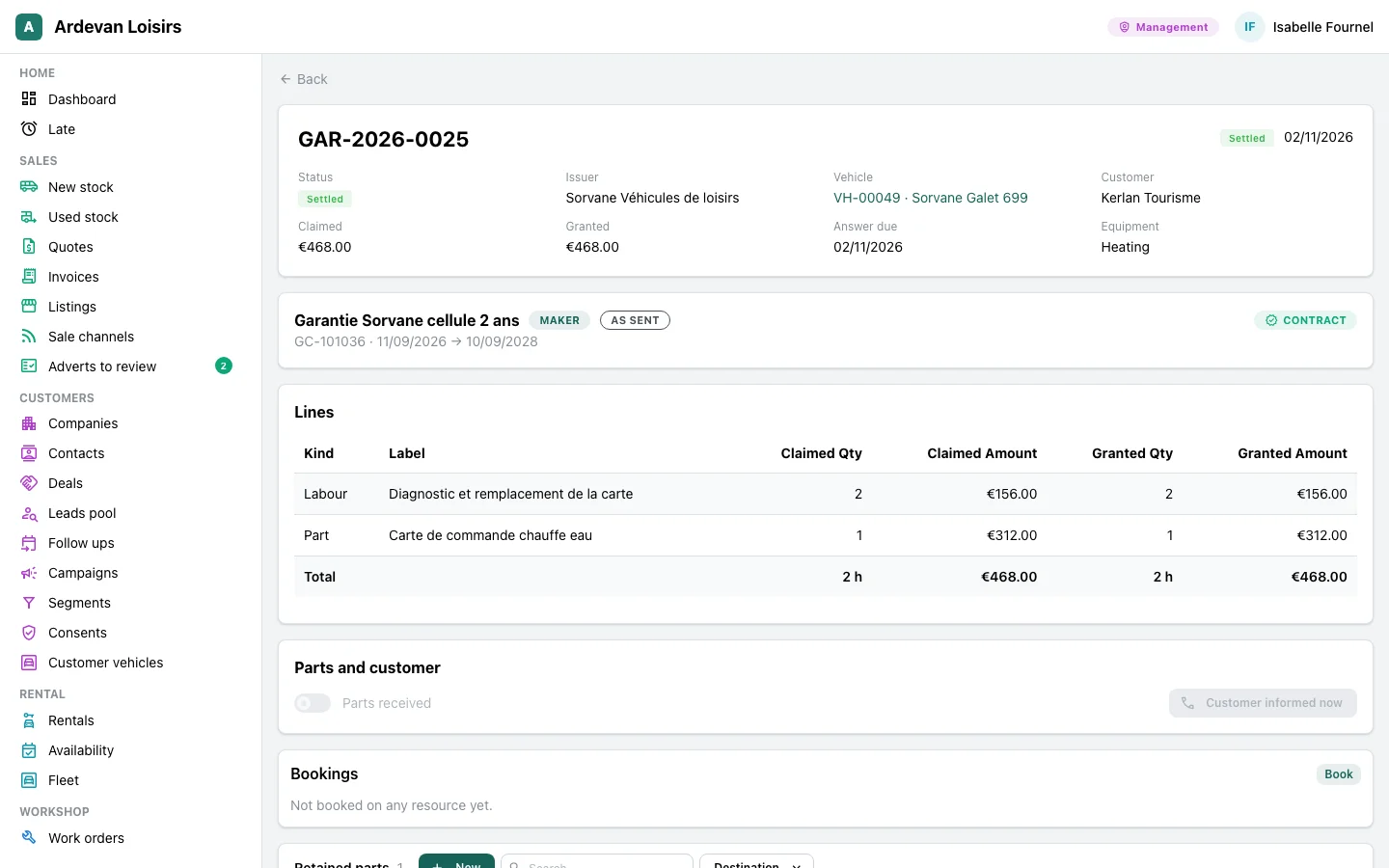
The answer is recorded line by line, the claim is settled with the issuer’s credit note, and the dashboard says who accepts what.
- Accepted, partly, refused with its reason: the granted total is always the lines’.
- Settled with the credit note’s reference and its date; a settled claim never changes and is never deleted.
- The parts to release: shipped to the issuer, destroyed or kept, each on its day.
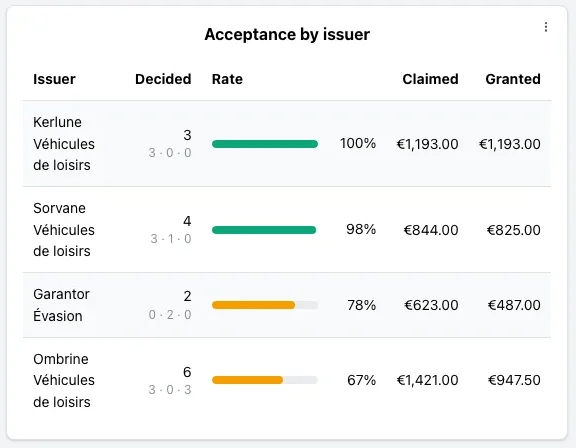
- Each issuer’s acceptance rate on the dashboard, and the amount granted against the amount claimed.
The trades that use it
The same module, with each trade’s goods, covers and issuers.
Leisure vehicle dealers
The cell and base vehicle warranties, leak tightness, extensions and the dealer’s own warranty, and the claims with each maker. The dealers’ page tells this desk.
At the warranty desk →Your trade
An appliance repairer claiming from the brand, a bike shop, a boat yard facing the insurer: the same screens, with your words.
Let’s talk →
With the other modules
It reads what the other modules already hold, with nothing typed twice.
Work orders and workshop
The claim is declared from the work order, and its warranty lines are billed into it.
See the module →Tracked goods
The covers are the good’s own, in its file, with their contract.
See the module →Campaigns and consents
The covers that end: a campaign offers their extension to the customers who said yes.
See the module →Planning
The customer’s appointment once the grant is in and the part has arrived.
See the module →
Your covers, your claims
GoLocomotive is in private testing. Access is by invitation. Once you are invited, we show you this module on your trade, with your issuers.