 GoLocomotive
The journal
Who changed what, and when, in your app’s words
A price that moved, a deal marked lost, a discount too generous: the journal says who did it, when, what was there before and what is there after. Every app has it from day one, and your team cannot touch it up.
What the module does
One row per write and per sign in, kept for good, readable by the person looking for it.
Every write
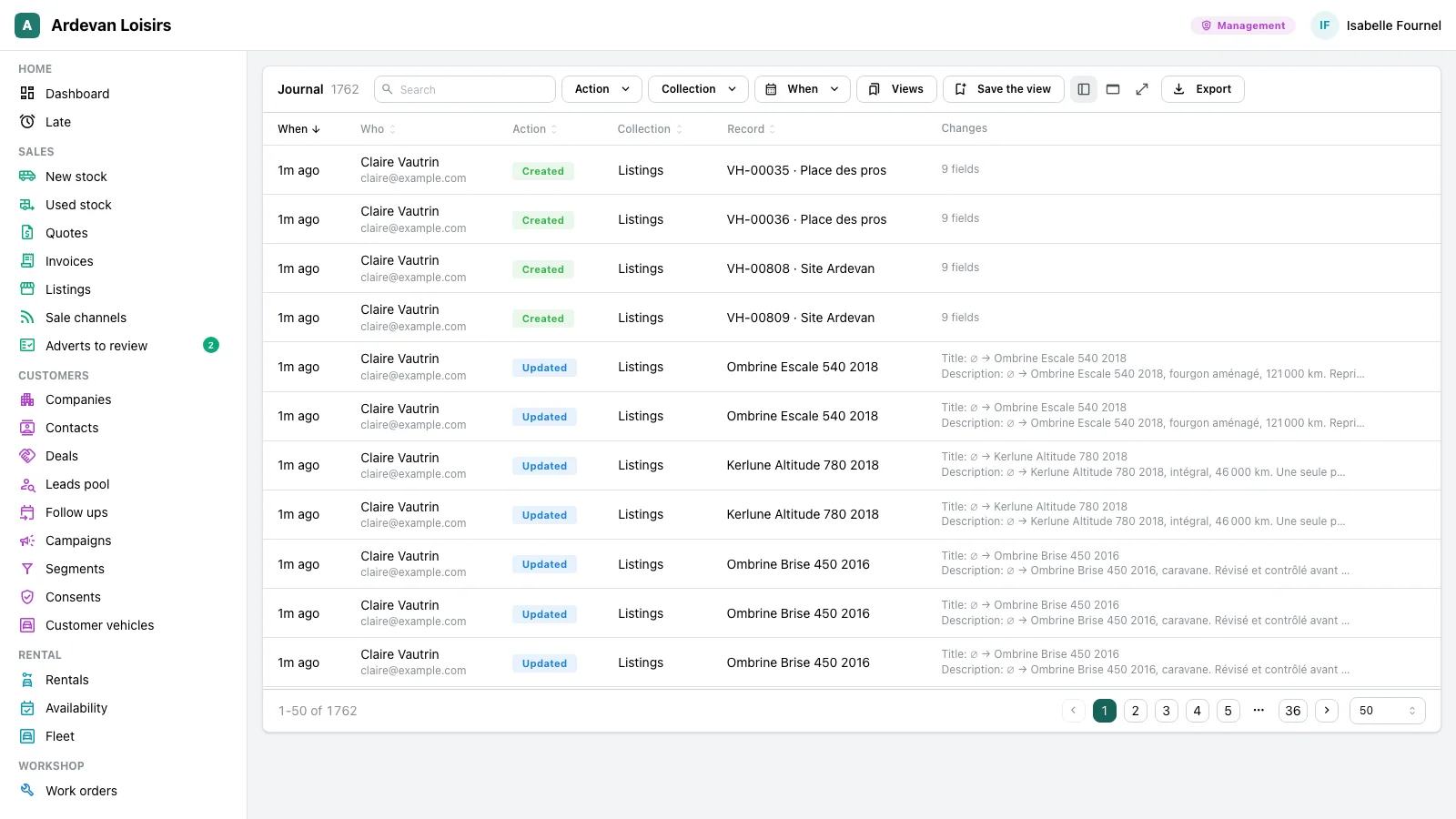
Each creation, change and deletion: who, when, and the before and after of each field changed.
Every sign in
Each sign in, by password or by code, with its device, and each refused attempt.
In your app’s words
Each table by its screen’s name, each field by its column’s name, in the reader’s language.
Out of the team’s reach
No account of your team, management included, edits or deletes a row. The journal also says whether a write came from a person, a batch or your AI.
Read by whom you choose
The journal shows to the people you name, management for instance; the others do not see it.
Searched, filtered, exported
By period, person, action or table; a search on a number finds its rows; the export as a spreadsheet.
Not there yet
- A record’s history on the record itself: today, a search on its number in the journal finds it.
- The writes the server makes on its own, a scheduled task for instance: the journal follows people, imports and your AI.
Screen by screen
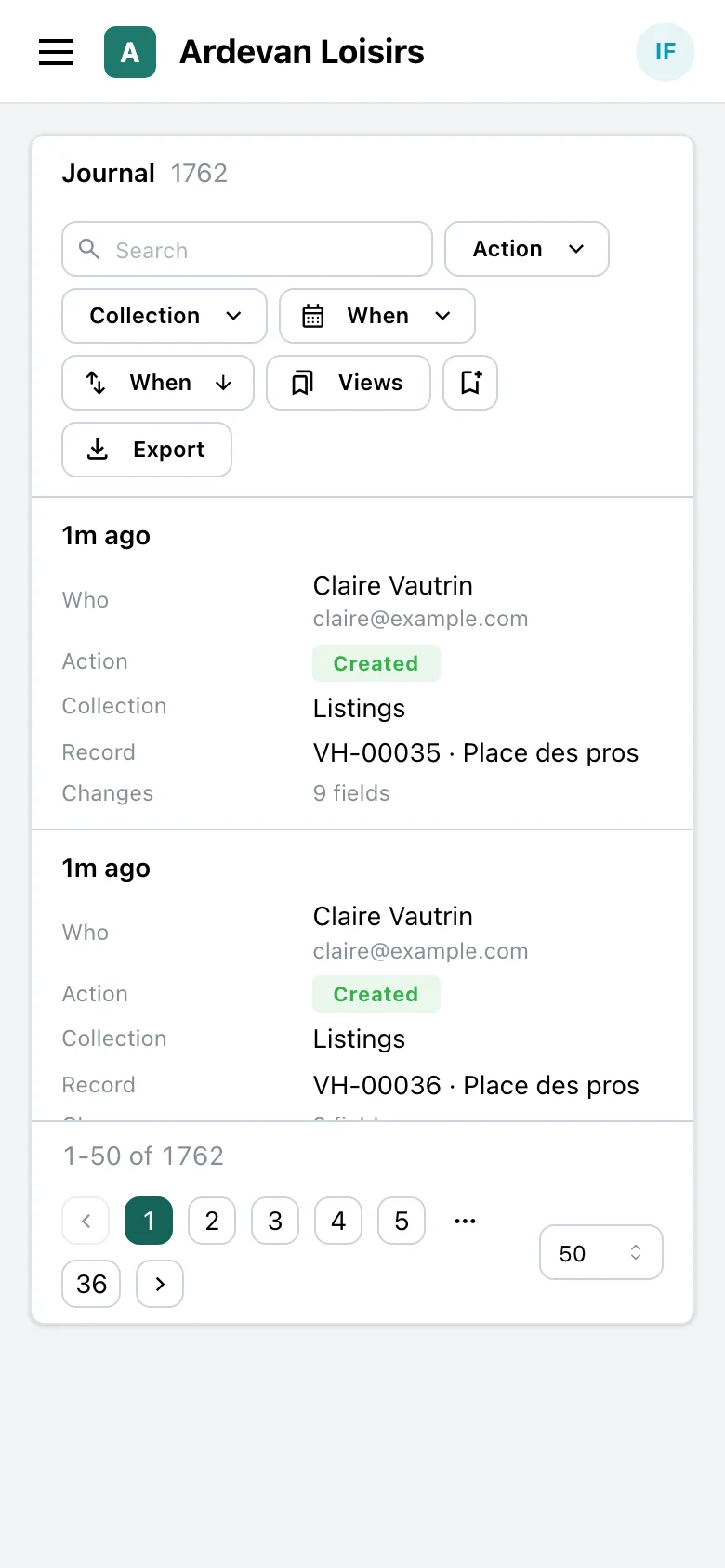
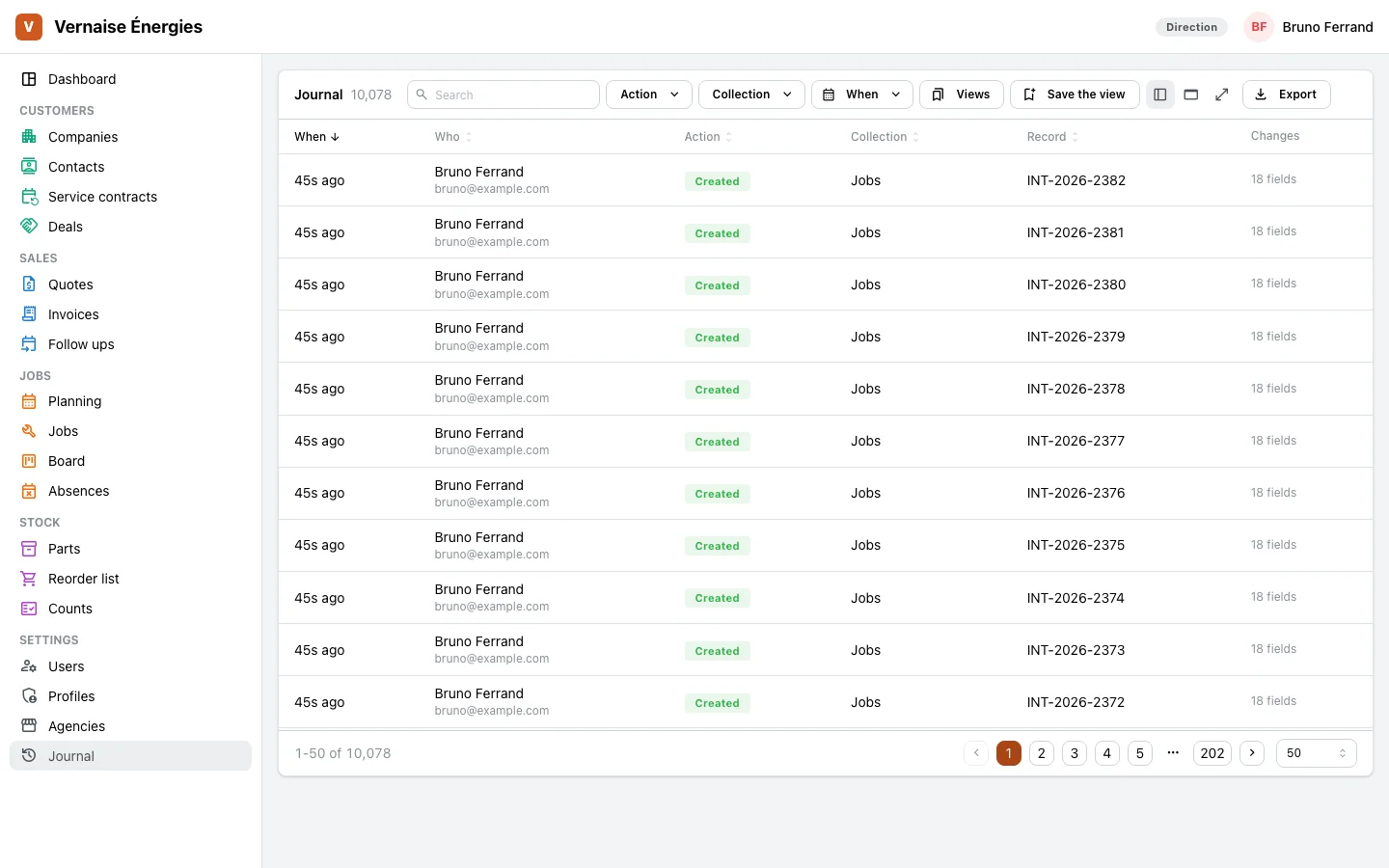
The screens come from the example apps of a leisure vehicle dealer and of a heating firm, on made up data.
Management, administrators
Know who did what
The day a question comes up, a price, a discount, a deleted record, the answer is in the app: who, when, before, after.
- Each row: when, who, the action, the table, the record, and the fields changed with their before and after.
- Each sign in too, by password or by a code received by mail; a refused attempt keeps the identity typed, never the password.
- Filters by action, table and period, and saved views.
- The export as a spreadsheet, for an inspection or an accountant.
Every app
In each app’s words
The journal names each table as its screen and each field as its column: it speaks your trade’s language, with nothing to set up.
- At the dealer, “Work orders”; at the heating firm, “Jobs”.
- A record with no name of its own is named by what it links to: an advert by its vehicle and its channel.
- In French or in English, as the reader reads.
The trades that use it
Every app has its journal from day one.
Leisure vehicle dealers
The deals, quotes, invoices, vehicles, the workshop, the warranty desk and the rentals, and every sign in.
The dealers’ page →Heating firms and field service
The jobs, quotes, contracts and invoices, under the names the app gives them.
The field service page →
With the other modules
It reads the writes of every module of your app.
Customers and deals
Each deal that changes stage, amount or salesperson.
See the module →Quotes and invoices
Each quote, each invoice, each payment.
See the module →AI that drafts, people who confirm
A write made by your AI is recorded as such: the journal knows what came from it.
Your app, its journal
GoLocomotive is in private testing. Access is by invitation. Once you are invited, we show you the journal on your trade.